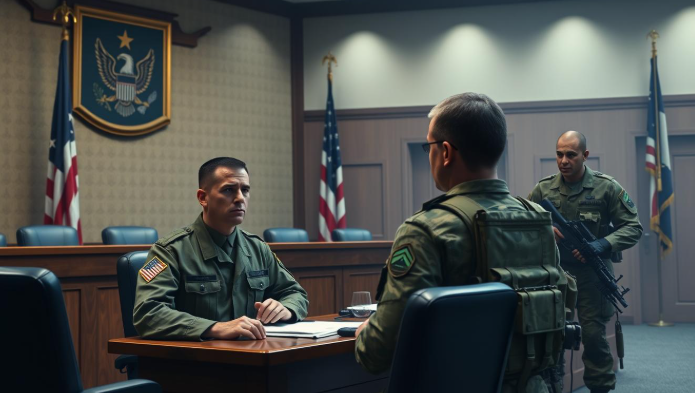
You might be feeling like your life just split into a “before” and “after.” Before the investigation or accusation, things felt demanding but normal. After the command meeting, the NCIS or OSI interview, or the charge sheet being read, everything changed. Your career, your reputation, your family life, even your freedom might suddenly feel at risk, and you may be realizing how important it is to have an experienced court-martial lawyer by your side.
That kind of shock is real. You may be replaying conversations in your head, wondering what you should have said differently, or worrying about what your command thinks of you now. At the same time, you are being handed terms like Article 15, summary court martial, general court martial, or “special court” and expected to understand what they mean for your future.
Here is the core truth. UCMJ charges are serious, but they are not the end of the story. There are rules that protect you. There are ways to challenge evidence. There are strategies to reduce charges or even win outright. You are not powerless, even if it feels that way right now.


This guide will help you understand what Uniform Code of Military Justice charges actually are, how the system around you works, and how to start building a strong military criminal defense step by step.
What do UCMJ charges really mean for your career and your freedom?
The Uniform Code of Military Justice is the law that governs service members. It covers everything from minor misconduct to serious felonies. Over the last few years, there have been important changes that affect how certain offenses are handled. For example, Congress and the Department of Defense have updated procedures and punishments for several offenses, including sexual assault and domestic violence. You can see an overview of some of these recent UCMJ changes from an Air Force perspective.
So where does that leave you? When you are facing UCMJ accusations and defense planning, you are really dealing with two overlapping realities. One is legal. The other is personal.
On the legal side, your case might involve:
- An administrative action, like a letter of reprimand or counseling
- Nonjudicial punishment under Article 15 or Captain’s Mast
- A summary, special, or general court martial
On the personal side, you might be pulled from your normal duties, placed on legal hold, or reassigned. You may feel isolated from your unit. Family members might be asking questions you are not ready to answer.
Because of this tension, you might wonder whether you should “just take” a deal, stay quiet and hope it goes away, or fight everything aggressively. Each choice has consequences. The key is to understand the system before you make any major decision.
See also: Technical Format Listing Noted for 1.00E+10 and Related Call Mentions
Why does the military justice process feel so overwhelming?
Part of the stress comes from the structure itself. The Manual for Courts Martial is long and technical. The 2024 edition, which applies across the services, spells out offenses, procedures, and punishments in detail. You can see the full current rules in the official 2024 Manual for Courts Martial.
On top of that, there are layers of instructions and service specific regulations. It is no surprise that many service members feel lost after their first meeting with an investigator or trial counsel.
Here is a simple way to think about it.
First, there is the accusation or suspicion. Maybe a financial audit flagged something, a relationship ended badly, or a random inspection found drugs or unauthorized items. Then an investigation starts. You might be questioned by law enforcement or command. At some point, your chain of command decides whether to handle it administratively, through nonjudicial punishment, or through a court martial.
Each stage has risks:
- Speaking without understanding your rights can create damaging statements.
- Agreeing to NJP without advice can lock in consequences that affect rank, pay, and promotion.
- Going to court without a solid strategy can put your freedom and discharge status on the line.
Imagine two different service members accused of similar misconduct. One talks freely “to clear things up,” signs whatever is put in front of them, and hopes their good record will save them. The other pauses, asserts their right to counsel, and works closely with a military criminal defense lawyer to gather evidence, identify witnesses, and challenge the accusations. The facts might be similar, yet the outcomes can be completely different.
That is why understanding your options and building a defense early is so important.
Should you handle UCMJ charges on your own or rely on a professional defense?
You technically have the right to represent yourself. You also have the right to free military defense counsel. You can often hire a civilian criminal defense lawyer with military experience as well. So how do you decide what makes sense for you?
The comparison below is not about scaring you. It is about helping you see what is really at stake so you can make a clear decision instead of a rushed one.
| Approach | What it looks like in practice | Key risks | Potential benefits |
|---|---|---|---|
| Handling it yourself | You answer questions, speak to your command, and respond to paperwork without legal guidance. | Unintended admissions, missed deadlines, failure to challenge weak evidence, long term impact on discharge and benefits. | You feel more in control in the short term. No cost for legal fees. |
| Relying only on assigned counsel | You work with your military defense attorney, who often carries a heavy caseload but knows the system well. | Limited time and resources, less ability to bring in independent experts or investigators. | No cost, access to someone trained in the UCMJ and local command culture. |
| Partnering with an experienced civilian military defense lawyer | You create a focused defense strategy, often with extra investigation, expert witnesses, and tailored negotiation. | Legal fees, need to coordinate with assigned counsel and command. | Dedicated time, aggressive review of evidence, stronger leverage in negotiations, clearer plan for protecting career and post service life. |
When you see it laid out like this, you can start to ask better questions. What is the worst realistic outcome in your case? What would it mean to lose your rank, your clearance, or your retirement? How much is it worth to reduce those risks?
For context, the 2019 Manual for Courts Martial includes detailed tables of maximum punishments for each offense. Even relatively “minor” sounding charges can carry confinement, reduction in rank, and punitive discharges. You can see those punishment rules in the official 2019 Manual for Courts Martial.
What immediate steps can you take to protect yourself right now?
You do not need to understand every article of the UCMJ to start defending yourself. You only need to take a few smart, focused actions.
1. Stop guessing and protect your right to remain silent
If you are under investigation or suspect you might be, you have the right to remain silent and the right to counsel. You do not have to “clear things up” in an interview without advice. You can simply say you wish to speak with an attorney before answering any questions. That choice cannot legally be held against you at trial.
This is not about looking guilty. It is about not giving investigators or command statements that can be taken out of context and used against you later.
2. Start building your own record of what happened
Memories fade quickly, especially when you are under stress. Write down your version of events as soon as possible. Include dates, times, locations, names of people present, and any texts, emails, or messages that might support your story.
Think about who might be a helpful witness. That could include coworkers, supervisors, medical providers, or family members. A strong UCMJ defense strategy often turns on small details that would have been forgotten if they were not written down early.
You can also review the official short summary of UCMJ rules so you have a basic sense of the types of offenses and processes involved. A simple overview is available in this UCMJ summary document.
3. Get qualified legal advice before you make any major decision
Do not accept or refuse Article 15, request court martial, or agree to any deal before talking with a defense lawyer who understands military law. That might be your assigned counsel, a civilian attorney with UCMJ experience, or both working as a team.
A good defense lawyer will help you:
- Understand the exact charges and maximum punishments
- Evaluate the strength and weaknesses of the evidence
- Decide whether to negotiate or go to trial
- Plan for long term effects on discharge, VA benefits, and civilian employment
You do not have to commit to any course of action right away. You do need to understand what you are signing and what you are saying, because those choices can follow you for years.
Finding your footing again after UCMJ charges
Being charged under the UCMJ can make you feel like everything you have built is at risk. Your rank, your reputation, your sense of who you are as a service member might feel shaken. That reaction is normal. It is also not the whole story.
You still have rights. You still have the presumption of innocence. You still have the power to make smart choices about how you respond. With the right guidance and a clear defense strategy, many service members are able to reduce charges, avoid the harshest punishments, or even clear their names.
You do not have to go through this alone. Reach out to a trusted military criminal defense lawyer, gather your documents, ask hard questions, and insist on a defense that treats your career and your future as seriously as you do.